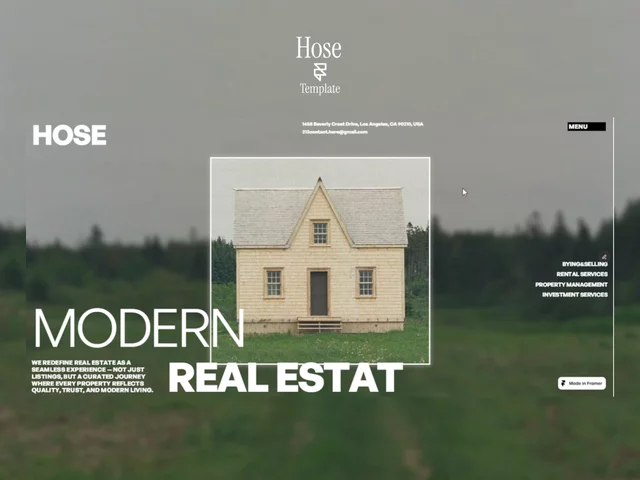
PropertyPeak is a Framer template for property brokerages that sell a short list well rather than a long one badly.
The layout is editorial: warm near-black and alabaster grounds alternating section by section, with one copper accent held back for prices, calls to action and active states. Erode sets the headings, Archivo carries every number with tabular figures, so prices and floor areas align in a column instead of drifting.
Ten pages ship ready — home, listings, property detail, districts, about, journal, article, contact, legal and 404. Six CMS collections sit behind them: Properties with thirty fields, plus Areas, Agents, Property Types, Journal and Legal, wired with references so a listing pulls its own district and adviser automatically.
Three breakpoints are built as replicas, so structural edits propagate instead of being repeated. Two layout templates carry a fixed navigation and a shared footer across every page.
Five components do the interactive work: a button with a hover text-roll, a navigation with a mobile drawer that closes on tap, a footer, an accordion, and a submit button with pending, success and error states.
The details took the longest. A working district filter bound to a page variable, with a proper empty state. Property cards that stack and scrub on scroll, keeping each title and price visible as the next one settles. Navigation that flips light and dark per section. One easing constant across every reveal, with offsets staggered by role, so the whole site moves as a single system.
Fifteen colour styles, twenty-one text styles with responsive sizes built into the presets, two link styles. Change a token, change the site.
Demo content is a fictional Copenhagen brokerage, written to show how the layouts behave at real sentence lengths. Imagery is Unsplash placeholder — every image is a CMS field.

PropertyPeak is a Framer template for property brokerages that sell a short list well rather than a long one badly.
The layout is editorial: warm near-black and alabaster grounds alternating section by section, with one copper accent held back for prices, calls to action and active states. Erode sets the headings, Archivo carries every number with tabular figures, so prices and floor areas align in a column instead of drifting.
Ten pages ship ready — home, listings, property detail, districts, about, journal, article, contact, legal and 404. Six CMS collections sit behind them: Properties with thirty fields, plus Areas, Agents, Property Types, Journal and Legal, wired with references so a listing pulls its own district and adviser automatically.
Three breakpoints are built as replicas, so structural edits propagate instead of being repeated. Two layout templates carry a fixed navigation and a shared footer across every page.
Five components do the interactive work: a button with a hover text-roll, a navigation with a mobile drawer that closes on tap, a footer, an accordion, and a submit button with pending, success and error states.
The details took the longest. A working district filter bound to a page variable, with a proper empty state. Property cards that stack and scrub on scroll, keeping each title and price visible as the next one settles. Navigation that flips light and dark per section. One easing constant across every reveal, with offsets staggered by role, so the whole site moves as a single system.
Fifteen colour styles, twenty-one text styles with responsive sizes built into the presets, two link styles. Change a token, change the site.
Demo content is a fictional Copenhagen brokerage, written to show how the layouts behave at real sentence lengths. Imagery is Unsplash placeholder — every image is a CMS field.
 Noel Dario Andres